Maintenance
Part of What matters most in batteries and charging in 2027
Battery care checklist for daily charging, storage, and safe travel
Battery care checklist for heat control, charging equipment, software settings, storage, spare cells, airline travel, warning signs, service, and recycling.
What to take away
- Use the battery, charger, and cable within the manufacturer's temperature, voltage, and power limits.
- Prevent heat and physical damage instead of chasing a perfect daily charge percentage.
- Store loose cells so terminals cannot contact metal, and keep batteries away from children.
- Check current airline and carrier rules before every trip because installation and watt-hour rating matter.
- Treat swelling, leakage, smoke, odor, hissing, or abnormal heat as safety signs, not ordinary aging.
This checklist covers common portable electronics. Vehicle, mobility, medical, aviation, marine, and stationary storage batteries can require specialized procedures. The physics behind each item here is explained in batteries and charging.
Daily charging
- The charger and cable meet the device's documented requirements.
- Connectors fit securely without force or pressure at an angle.
- Cables have no split insulation, bent contacts, or exposed conductors.
- The adapter is dry, ventilated, and not covered by bedding or clothing.
- The device is away from direct sun, heaters, and trapped heat.
- Multiport power limits remain adequate when all devices are connected.
- Repeated charging interruptions or unusual sounds are investigated.
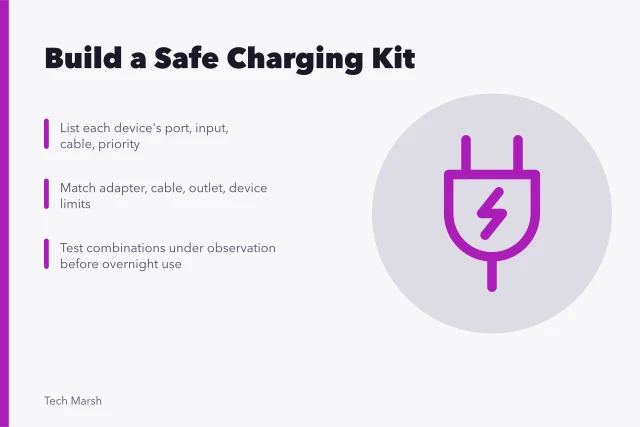
If a product becomes hotter than usual, pause and check workload, environment, charger, cable, and product warnings. Testing each adapter and cable combination once, under observation, is part of how to build a safe charging kit. Do not cool a hot device with water, ice, or a freezer.
Software and usage
- Battery-usage reports are reviewed before blaming hardware.
- High screen brightness, weak signal, location work, gaming, and camera use are considered.
- Background work after setup or an update is allowed to finish.
- Supported optimized-charging or charge-limit features match the routine.
- The operating system and battery firmware are current.
- Unexpected shutdowns, health messages, and service notices are recorded.
The chemistry sets the schedule. A lithium-ion battery loses capacity through charge cycles and calendar aging even in storage, while heat and sustained high charge levels speed degradation and raise internal resistance, trimming the power it can deliver at once.
Products report the resulting health differently, so use each product's specific diagnostics. Read that report before blaming the pack, the order used in common smartphone problems and fixes.
Removable cells
- Chemistry, size, voltage, polarity, and rechargeability match the device.
- Mixed brands, ages, capacities, and charge states are avoided in a set.
- Single-use cells are never placed in a rechargeable-cell charger.
- Loose cells are stored in cases or packaging that protects terminals.
- Coin and button batteries are secured away from children.
- Cells are removed from long-unused equipment when instructed.
Do not carry loose batteries in a pocket or drawer with keys, coins, tools, or foil. Which chemistry belongs in which device is set out in consumer battery types compared.
Long-term storage
- The manufacturer's recommended storage charge is used.
- The device is powered down as instructed.
- Storage is cool, dry, and within the stated temperature range.
- Heavy objects cannot crush or puncture the battery or device.
- The charge state is checked at the recommended interval.
- Swelling, leakage, corrosion, odor, or damage is checked before reuse.
Travel by air
- Battery chemistry and watt-hour rating are known.
- Spares and power banks are packed in carry-on baggage as required.
- Terminals are protected against short circuit.
- Installed devices are protected from damage and accidental activation.
- Damaged, defective, or recalled batteries are not packed.
- Airline-specific quantity and approval limits are checked.
- Gate-check plans include removing items that must stay in the cabin.
FAA's PackSafe rules for passengers require power banks, spare batteries, and lithium batteries under 160 watt hours to stay in the cabin. They bar larger rechargeable units from passenger aircraft and damaged or recalled batteries unless made safe.
Carrier rules may be stricter. Travelers who pack spare cells should also review the smart home battery replacement schedule before a long trip.
Service and retirement
- Important data is backed up before battery service.
- The product is checked for recalls by model and serial number.
- A swollen or damaged pack is not pressed, punctured, or mailed casually.
- The manufacturer or local hazardous-waste program provides handling advice.
- Rechargeable batteries avoid household trash and curbside recycling.
- Terminals are prepared for collection as the local program requires.
- Service records and replacement part details are retained.
Common questions
Must I keep the battery at exactly 80 percent?
No universal percentage fits every product and routine. Use supported controls and avoid unnecessary heat.
Can a power bank go in checked baggage?
FAA rules treat power banks as spare lithium batteries and require them in carry-on baggage. Check the current airline rules too.
Should I drain a stored device completely?
Follow the manufacturer's storage charge. Deep discharge during storage can prevent later recovery.
Is short runtime always a safety problem?
No. It can reflect workload, settings, signal, temperature, or normal aging. Physical warning signs require a different response.