Guides
Solar Generator vs Portable Power Station: What Actually Backs Up Your Home?
Solar generator vs portable power station: what each one actually backs up in a US outage, what it costs in dollars, and where both fall short.
What to take away
- A portable power station is a battery in a box with outlets. A solar generator is that same box plus panels and a charge controller. The battery is the part that runs your fridge.
- Neither one backs up a whole house. They run selected loads: fridge, router, phones, a lamp, a CPAP.
- Runtime comes from watt-hours divided by load. A 1,000 Wh station running a 100 W load lasts about 10 hours at best, less after inverter losses.
- Expect roughly $0.70 to $1.20 per watt-hour for name-brand units in the US, before panels.
- Look for a UL 2743 listing on the unit and UL 3700 on any panel kit, not just a CE mark.
What is being compared
Two product categories get sold under one phrase, and the confusion starts there. A portable power station is a lithium battery, an inverter, and a set of outputs in a plastic case. A solar generator is the same unit sold with folding panels and a charge controller, sometimes bundled, sometimes separate.
That means the comparison is not really two machines. It is one machine, plus a question about how you refill it. The Wikipedia entry on solar generators covers the components and typical capacity ranges, and the framing matches what US retailers ship.
The practical difference shows up on day three of an outage, when the wall outlet is still dead and the battery is empty. Panels decide whether you keep going.
The criteria that matter
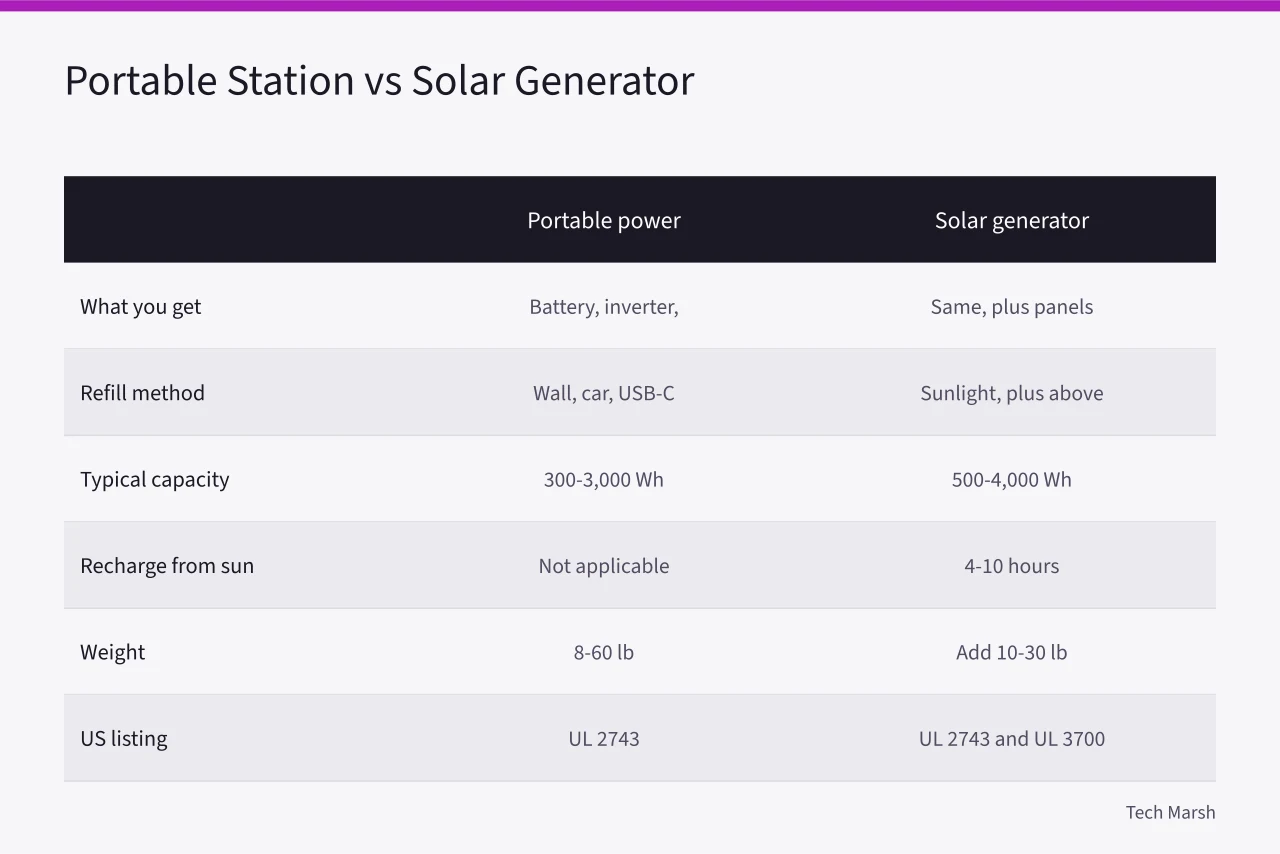
| Criterion | Portable power station | Solar generator |
|---|---|---|
| What you get | Battery, inverter, outlets | Same, plus panels and controller |
| Refill method | Wall outlet, car 12 V, USB-C | Sunlight, plus the above |
| Typical capacity | 300 Wh to 3,000 Wh | 500 Wh to 4,000 Wh |
| Recharge time from sun | Not applicable | 4 to 10 hours, weather dependent |
| Weight | 8 to 60 lb | Add 10 to 30 lb for panels |
| US listing to check | UL 2743 | UL 2743 and UL 3700 |
| Price band | $250 to $3,000 | $500 to $5,000 |
Capacity is the number buyers misread. A 1,000 Wh rating is not 1,000 W of output. Watt-hours measure stored energy; watts measure how fast you can draw it. A unit with a 1,000 Wh battery and a 500 W inverter will not start a fridge whose compressor surges past that ceiling.
Outage length is the other axis. Most US residential outages last a few hours, but storm-driven ones in the Southeast and Gulf Coast can run for days. The US Department of Energy tracks these events, and the pattern is that a small number of long outages cause most of the lost hours.
Option by option
Jackery Explorer 1000 v2. Around 1,000 Wh, roughly $700 to $1,000 depending on the bundle. It runs a fridge, a router, and phone charging for most of a day. Add two 200 W panels and a clear sky and you can top it up in a long afternoon. The panels cost extra.
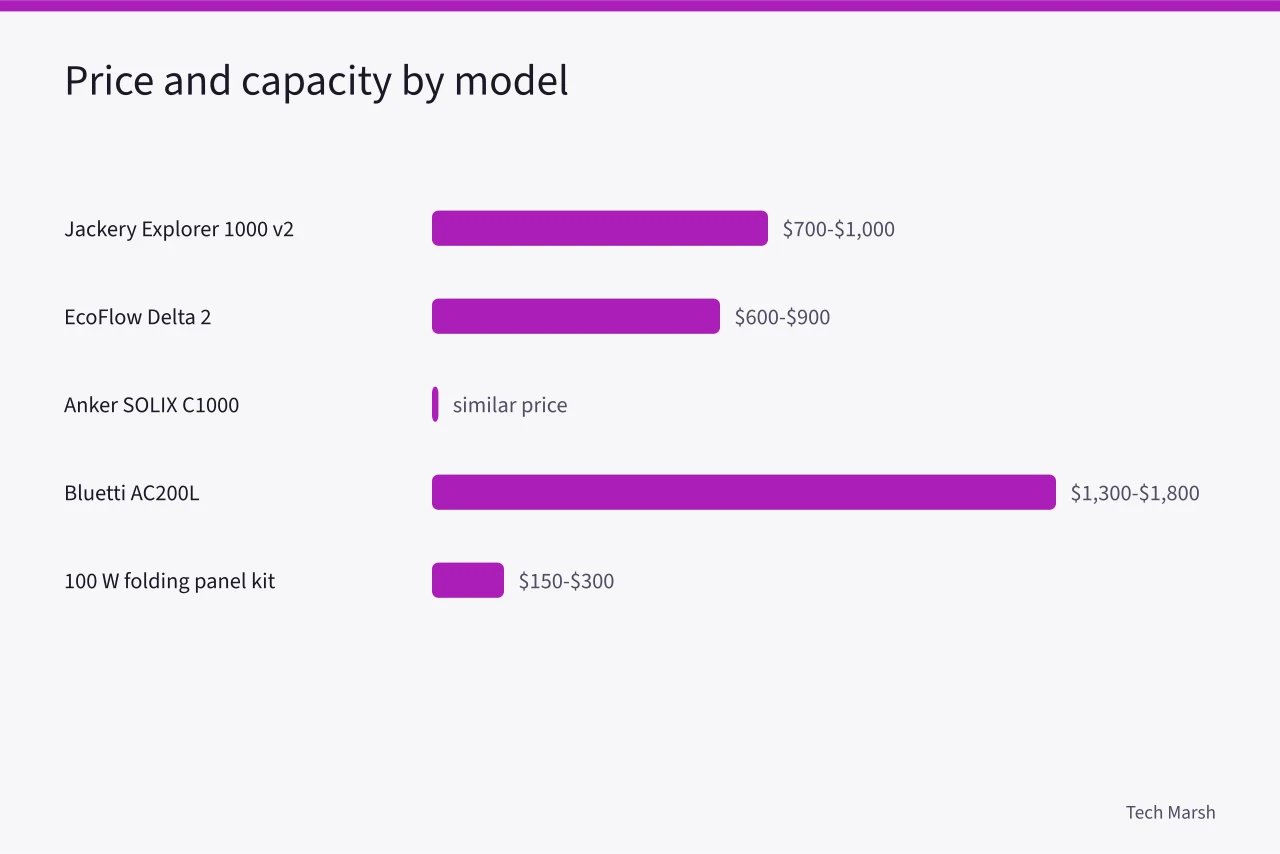
EcoFlow Delta 2. Around 1,000 Wh with a higher inverter rating than the Jackery, so it starts more motor loads. Street price sits near $600 to $900. EcoFlow also sells a 12 V output and an expansion battery, which matters if you want to grow later.
Anker SOLIX C1000. Similar class, similar price, and it charges fast from a wall outlet. That speed is useful before a storm, not during a week-long outage.
Bluetti AC200L. Around 2,000 Wh, roughly $1,300 to $1,800. This is the size where a fridge plus a freezer plus lights becomes realistic for two days.
Any 100 W folding panel kit. $150 to $300. Panels are the weakest link in every bundle. Rated watts assume full sun and correct angle, which you rarely get on a cloudy day in Seattle or a shaded lot in Chicago.
Where each one wins
A portable power station is right when outages are short and you have a working wall outlet between them. Charge it in the garage, wheel it inside, run the fridge overnight. This is the common case in most US cities.
A solar generator is right when outages are long, the sun is reliable, and you cannot leave the house. Think rural Georgia in July or a wildfire shutoff in California. Panels turn a one-day battery into a multi-day supply.
A third case is the apartment dweller. Panels need an outdoor space, a balcony rail, or a yard. Without that, the solar half of the bundle is dead weight, and a plain station plus a car charger is the better buy.
If you are weighing this against a fixed system, our comparison of home battery options is not the right page; that one covers data, not power. For sizing rules that apply to any lithium pack, the battery safety guide is worth reading before you buy.
What none of them solve
No portable unit runs central air conditioning, an electric furnace, or a heat pump for more than minutes. Those loads draw thousands of watts continuously. Neither category replaces a generator interlock or a standby system.
A 2,000 Wh station holds roughly the energy of two car batteries. A central AC unit can drain that in under an hour.
Safety rules apply to all of them. The National Electrical Code, NFPA 70, governs how backup power connects to a home's wiring, and backfeeding a dryer outlet is both illegal in most jurisdictions and dangerous to utility crews.
Every unit in both categories shares one hard limit: lithium cells age. Capacity drops with every cycle and with heat. A station stored in a Phoenix garage loses capacity faster than one kept at 70 F. Check the lithium-ion battery overview for how degradation works before you assume a five-year-old unit still holds its rated watt-hours.
Common questions
Can a solar generator run a refrigerator? Yes, if the inverter rating covers the compressor surge, often two to three times the running watts. A 1,000 Wh station typically runs a modern fridge for 8 to 16 hours.
How many watts do I need for an outage? Add up what you must run, not what you want to run. Fridge, router, lights, and phone charging usually total under 500 W of continuous load.
Do I need UL certification? UL 2743 is the standard for portable power stations sold in the US. It covers cell safety, enclosure, and output protection. Ask the seller for the listing number.
Is a gas generator cheaper? Per watt, yes, often a third of the price. It needs fuel, outdoor placement, and maintenance, and it cannot run indoors. That tradeoff is the whole argument.