Rules
Right to Repair in Canada: What Device Owners Can and Can't Fix Under New Rules
Right to repair electronics Canada lacks a federal law; Quebec leads with fines, while soldered parts and paired batteries still block many DIY fixes.
What to take away
- Canadian right to repair has no single federal law; Quebec's Bill 29 is strongest, and other provinces rely on general consumer rules.
- A device owner with no parts budget can still fix many older screens and batteries, but soldered storage and paired parts are ruled out.
- The workaround stops paying at 60 percent of a used replacement device's price.
- US FTC right-to-repair actions do not apply in Canada.
Right to repair in Canada is a patchwork of provincial rules and federal promises. Quebec's Consumer Protection Act bans planned obsolescence and lets its consumer office fine sellers. Other provinces rarely force manufacturers to sell parts directly. The Wikipedia overview of right to repair explains how Canadian laws trail European spare parts rules.
The constraint in measurable terms
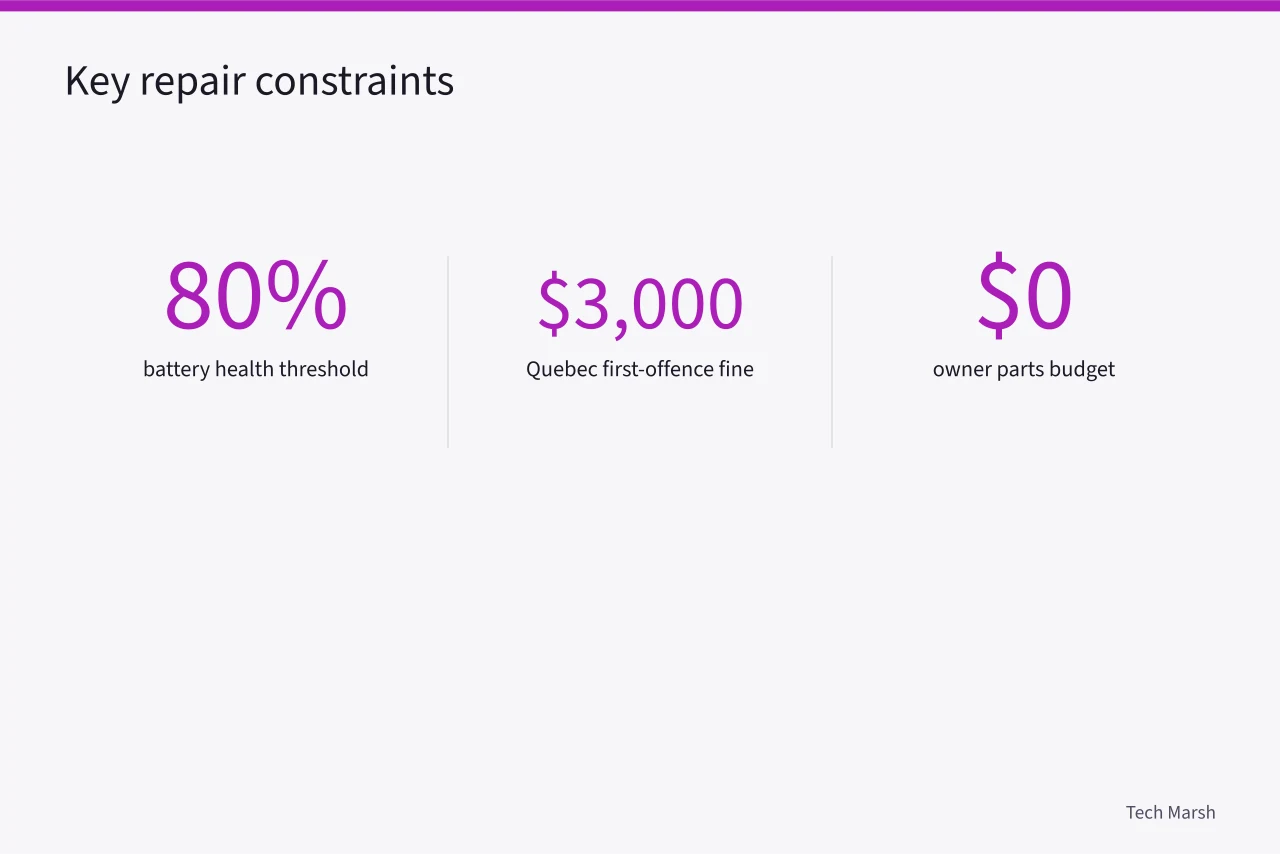
A single device owner has one pair of hands, one bench, and a parts budget of $0. Many 2020 and later phones glue batteries in place and pair batteries to the logic board. When battery health drops below 80 percent, iOS and Android show service warnings. That 80 percent threshold matters because below it a power bank stops being a useful workaround. Quebec sets a measurable penalty: a fine of up to $3,000 for a first planned obsolescence offence.
What the constraint removes
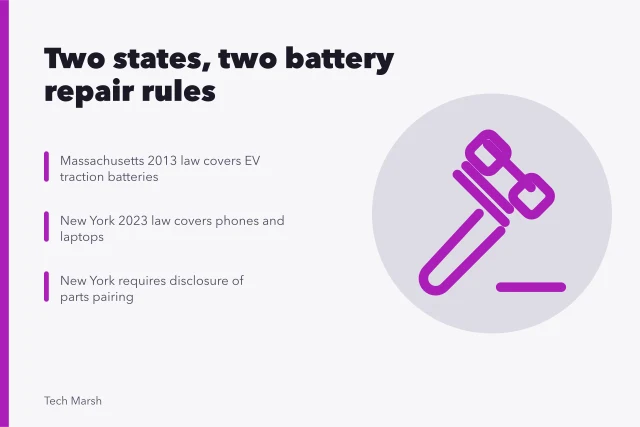
A no-budget owner loses Apple's self-service repair program because it requires renting tools and buying genuine parts at full price. Replacing a soldered storage chip on a MacBook Air M1 is ruled out; the NAND is not socketed and Apple sells no bare chips. Many screen repairs on a Samsung Galaxy S21 are also out in provinces without parts distribution. Massachusetts and New York right-to-repair laws change battery replacement in the US, but Canada has no federal equivalent. Canadian owners should check whether their province has a parts distribution rule before attempting a screen repair.
What still works
Battery replacement on older phones with removable backs, such as the Fairphone 4 sold in Canada, still works with a screwdriver. A cracked screen on an iPhone 8 works because the part is widely available and not paired. A swollen lithium-ion battery in a pre-2018 laptop is within reach. A cable swap for USB-C devices remains easy.
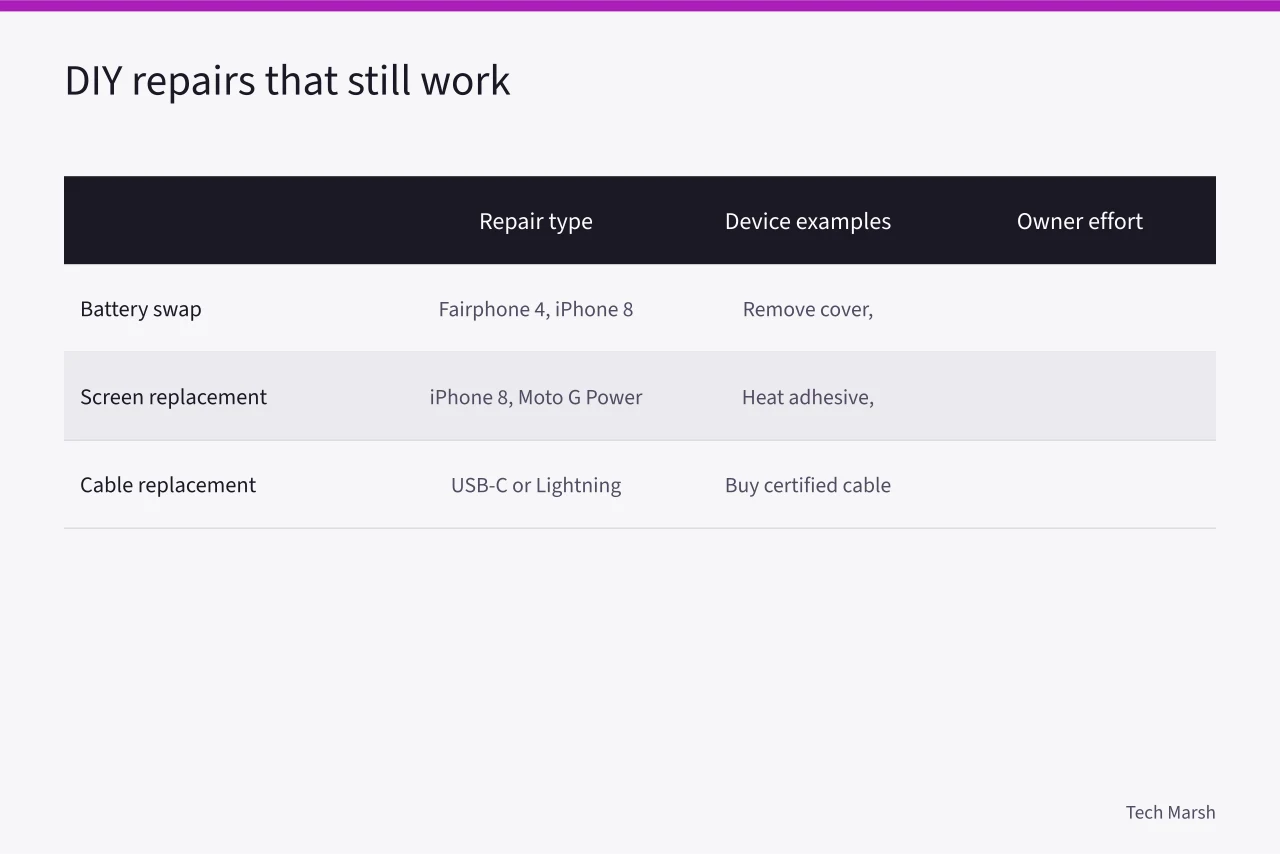
| Repair type | Device examples | Owner effort without a parts budget |
|---|---|---|
| Battery swap | Fairphone 4, iPhone 8, ThinkPad T480 | Remove cover, disconnect connector |
| Screen replacement | iPhone 8, Moto G Power (2021) | Heat adhesive, disconnect cables |
| Cable replacement | USB-C or Lightning cable | Buy a certified cable |
A good cable also carries the right data speed, and a bad one can drop a file transfer. For phones with USB-C, cleaning the port with a wooden toothpick removes lint that blocks charging. Older devices with standard Phillips screws are the most forgiving. A basic USB-C cable with 60-watt rating is enough for most phones and small laptops. The USB-C cable types and speeds guide helps identify a cable that works without a premium label.
Compromises worth making
- Limit charge to 80 percent using Android battery protection or iOS Optimized Charging to delay a battery swap.
- Use independent shops for labour-only jobs and bring your own part from MobileSentrix or iFixit Canada.
- Accept a cracked back glass with a skin instead of replacing it.
Compromises that are not
Do not use a third-party battery in an iPhone 12 or newer and expect full battery health data. Apple's parts pairing shows an unknown part warning and disables the health percentage. Do not attempt a screen repair on a Samsung Galaxy S21 with an aftermarket OLED panel. Colours shift and the fingerprint sensor fails. Do not try to swap storage on any modern MacBook; the NAND is soldered and a heat gun slip destroys the board.
When to stop and resource it properly
Stop when a repair quote reaches 60 percent of a used replacement phone. If a screen and battery quote is $240 and a used same model is $400, buy the used phone. For laptops, stop at 40 percent of a refurbished unit because board failures recur. Laptop repair costs compared in San Francisco, Austin, and Chicago show why board work prices out owners. Once you cross the line, use a shop with a microsoldering station or a provincial consumer office. Recycle the device through a provincial electronic waste program.
A single owner with no parts budget should not buy a heat gun, a microscope, and a hot air rework station for one repair. That setup costs more than the device and takes months to learn.
Battery safety from Arizona heat to Minnesota cold matters when you swap a phone battery yourself, because lithium-ion cells need stable room temperature.
Common questions
Is there a federal right to repair law in Canada? No. The federal government has promised a framework, but no statute is in force.
Which province has the strongest right to repair rules? Quebec. Its Consumer Protection Act bans planned obsolescence, though phones are not fully covered by parts requirements.
Can I legally repair my own phone in Canada? Yes. No Canadian law prohibits DIY repair. The problem is parts availability and software pairing.
When should I stop trying to fix a device myself? Stop when the repair quote reaches 60 percent of a used phone, or 40 percent for a laptop.