Reviews
Part of Smart home systems under review: the good, the weak and the verdict
Matter, Thread, Wi-Fi, and Bluetooth: smart home protocols compared
Smart home protocols compared by role, power use, range, controllers, internet dependence, commissioning, and compatibility across Matter, Thread, Wi-Fi, and more.
What to take away
- Matter defines how compatible smart-home products communicate, while Thread, Wi-Fi, and Ethernet can carry that communication.
- Bluetooth is often used during setup, but its presence does not prove how daily control works.
- Thread devices need suitable Thread network infrastructure, even when no dedicated branded hub is required.
- Wi-Fi offers direct IP connectivity but places each device on the household network and may draw more power.
- Compare the exact product, controller, feature, and platform combination, not protocol names in isolation.
Smart-home packaging mixes application standards, network transports, radios, ecosystems, and marketing labels. They describe different layers. A product can support several at once, and two products can share one badge while exposing different features. Where each layer sits in a working household system is mapped in the smart home systems guide.
Layer versus product
Use this simplified stack:
Smart home protocol layers
Layer
- application
- commands understood
- network
- how messages move
- commissioning
- secure introduction
- controller
- creates automations
- service
- outside the home
Main question
- application
- Matter, vendor systems
- network
- Thread, Wi-Fi, Ethernet
- commissioning
- QR, code, Bluetooth LE
- controller
- phone, hub, speaker
- service
- remote access, storage
Examples
- application
- network
- commissioning
- controller
- service
| Layer | Main question | Examples |
|---|---|---|
| application | What commands and device types are understood? | Matter, vendor-specific systems |
| network | How do messages move around the home? | Thread, Wi-Fi, Ethernet |
| commissioning | How is a new device securely introduced? | QR code, numeric code, Bluetooth LE |
| controller | What creates automations and accepts commands? | phone, hub, speaker, local server |
| service | What happens outside the home? | remote access, storage, notifications |
This explains why "supports Bluetooth" is not the same as "works by Bluetooth all day" and why a Matter device still needs a supported network path.
Matter
Matter is an IP-based application standard intended to improve compatible device communication across brands and platforms. It defines device behavior and commissioning, while products use supported network technologies underneath.
The Matter standard, stewarded by the Connectivity Standards Alliance, operates at the application layer on top of Internet Protocol, with official support limited to Wi-Fi, Ethernet, and the Thread mesh underneath. Certification can reduce some uncertainty, but buyers still need to check device type, specification version, controller support, and which functions a platform exposes.
Thread
Thread is a low-power IPv6 mesh network for connected devices. Mains-powered Thread devices can help carry messages across the mesh, while sleepy battery devices conserve energy. A Thread border router links the Thread network to the broader IP network.
Thread can suit sensors, locks, and other low-power devices. Coverage depends on placement, building materials, compatible routing devices, and a healthy border-router arrangement. A product may include border-router capability without being sold as a separate hub.
Wi-Fi
Wi-Fi devices connect through an access point and use the household IP network. Setup can be familiar, and higher bandwidth suits cameras and media devices. Each product still needs correct band support, coverage, credentials, updates, and account configuration.
Battery-powered Wi-Fi devices may wake only at intervals to conserve energy. A strong phone signal at the installation point does not prove the device's smaller radio will perform the same way. What a phone's own radios do and do not measure is set out in cellular, Wi-Fi, Bluetooth, NFC, and GPS compared. Cameras can also add sustained upstream traffic.
Ethernet
Ethernet gives a wired network path and stable bandwidth where cabling is practical. Some devices use Power over Ethernet, so one cable carries data and power. Its role in the home network is set out in Wi-Fi, Ethernet, mesh, and range extenders compared.
A wired camera or controller still depends on switches, routers, accounts, storage, and software.
Ethernet does not make a product automatically local or private. It describes the network connection, not where processing or control occurs.
Bluetooth
Bluetooth Low Energy is often used to discover and commission nearby devices. Bluetooth can also support ongoing point-to-point controls and sensors, depending on the product. Range, phone presence, gateway requirements, and background app behavior matter.
Do not assume a Bluetooth logo means a device participates in a Bluetooth mesh or remains controllable without another platform component.
Matter over Thread
Matter and Thread complement each other rather than compete: Matter provides the compatible application language.
Thread protocol is an IPv6-based, low-power mesh on the IEEE 802.15.4 radio standard. It uses 6LoWPAN to carry IP packets over low-bandwidth links, and border routers give a two-way path between the Thread mesh and Wi-Fi or Ethernet.
The household still needs a Matter controller that supports the device and, for Matter over Thread, suitable Thread border-router infrastructure. Confirm which resident account owns the home and how additional administrators are added.
Selection table
Candidate to examine first
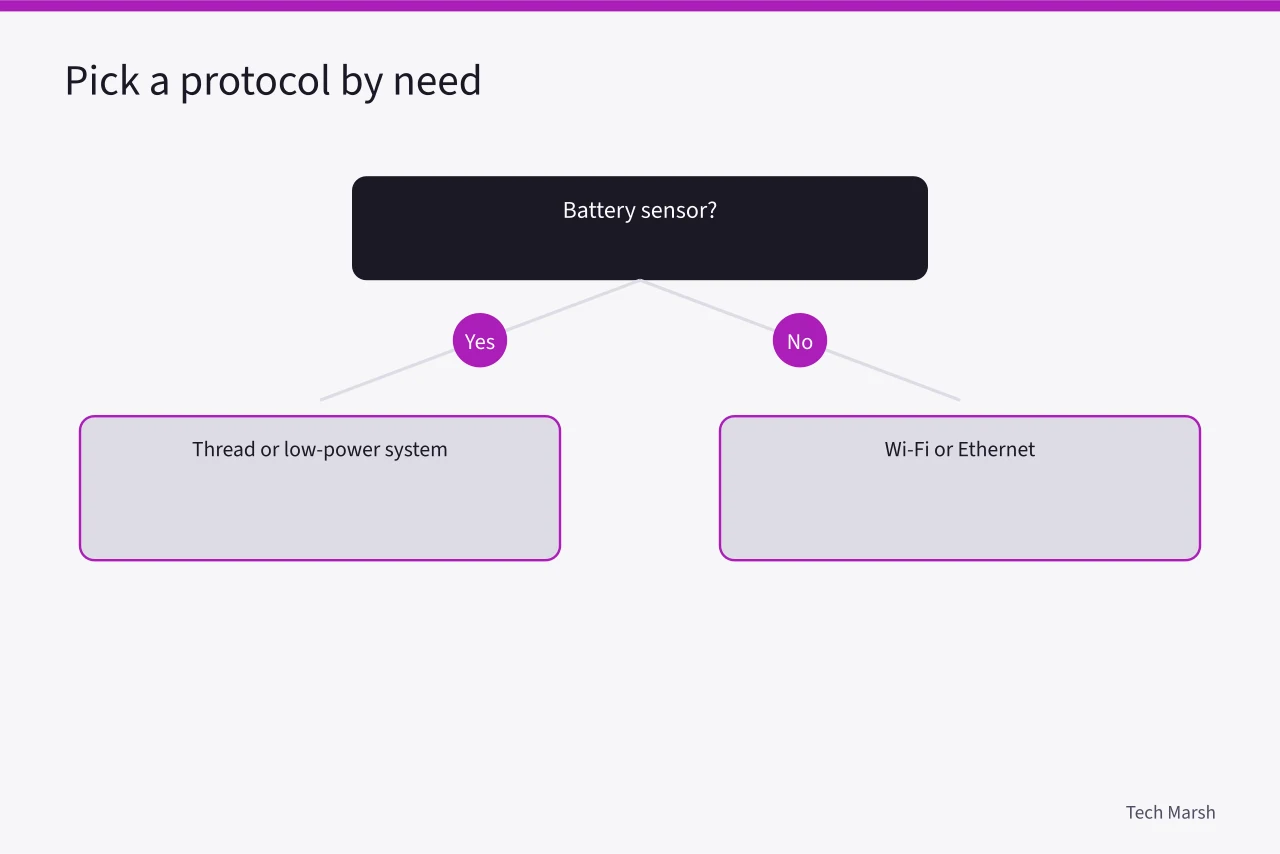
- battery sensor
- Thread or another low-power system
- high-bandwidth camera
- Wi-Fi or Ethernet
- fixed controller
- Ethernet or Wi-Fi
- cross-brand control
- Matter-certified candidates
- nearby setup
- Bluetooth-assisted commissioning
Verify before purchase
- battery sensor
- border router, range, battery, platform feature
- high-bandwidth camera
- upstream capacity, storage, power, privacy
- fixed controller
- local behavior, backup, updates, integrations
- cross-brand control
- device type, version, controller, exposed functions
- nearby setup
- fallback code, phone permissions, daily network
These are starting points, not automatic winners. Confirming the exact controller, feature, and platform before buying is an early step in how to set up a smart home.
Common questions
Is Matter a wireless radio?
No. It is an IP-based application standard that can operate over supported network transports.
Does Thread replace Wi-Fi?
No. They address different device and network needs and can operate in the same home.
Does every Thread device route messages?
No. Roles vary, and battery-saving end devices may not route traffic for others.
Does Ethernet guarantee local control?
No. A wired product may still depend on cloud accounts or remote processing.