Costs
How to Pick a Canadian Cell Phone Plan: CRTC Rules and Real Prices
The cheapest cell phone plan in Canada usually runs $25 to $45 a month, and CRTC rules decide what you get for it. Here is what the money buys.
What to take away
- The cheapest cell phone plan in Canada sits around $25 to $45 a month for 3GB to 20GB of 4G data, depending on province and whether you bring your own phone.
- The CRTC Wireless Code caps extra data charges at $50 a month, caps overage at $100 per account, and lets you cancel after two years with no fee.
- Rogers, Bell and Telus sell cheaper service through flanker brands: Fido, Koodo, Virgin Plus, Chatr, Lucky Mobile and Public Mobile.
- Quebec, Manitoba and Saskatchewan routinely list plans $10 to $25 below Ontario and the Atlantic provinces.
- A phone financed on a tab costs more over 24 months than the same phone bought outright and paired with a budget plan.
What the range covers
A no-contract plan in Canada in 2025 covers talk, text and a bucket of data on a 4G or 5G network. The published price assumes you own the phone. Add a device and the same plan can double.
Price tracks two things: how much data you take and where you live. Provincial competition decides the rest. The CRTC regulates the carriers, and its mandate covers telecom service quality and consumer protection, but it does not set retail prices.
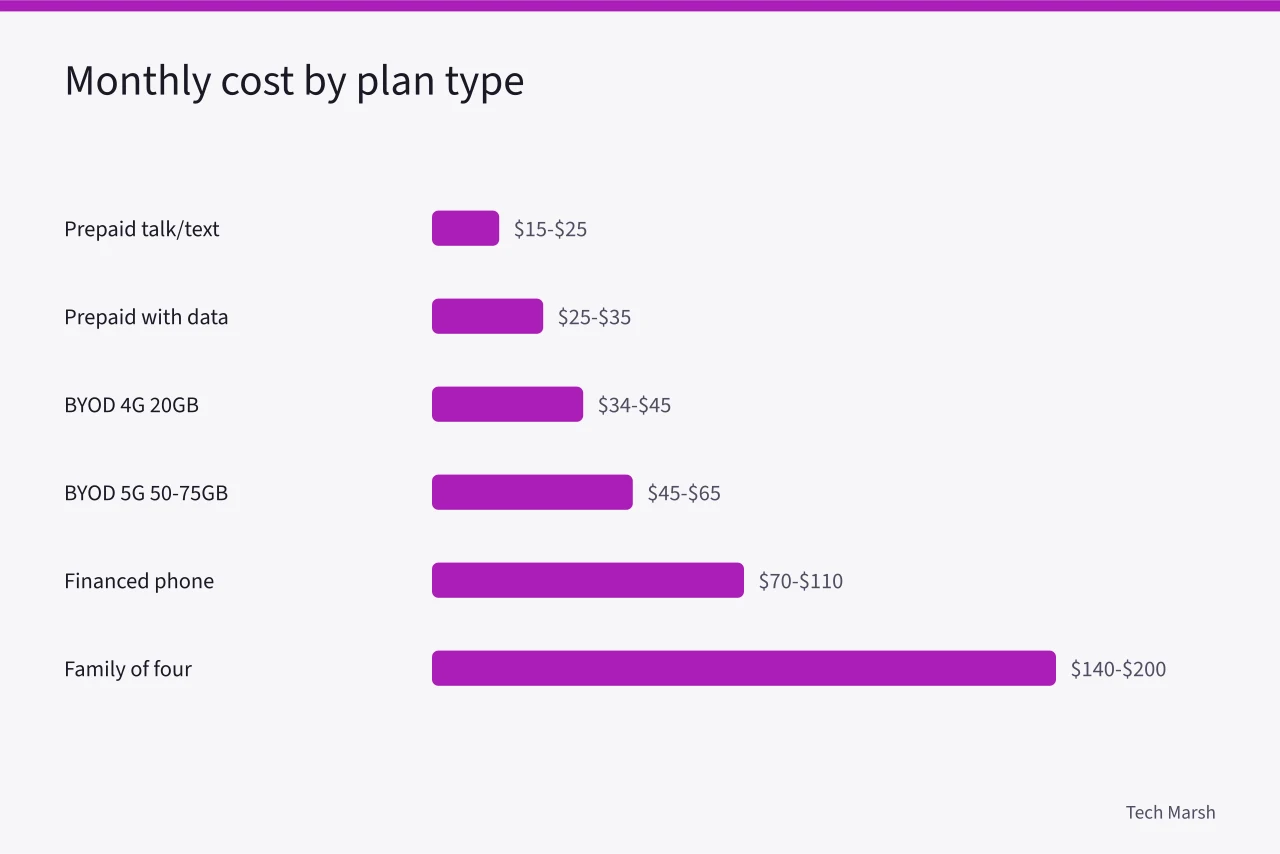
The figures below are illustrative ranges drawn from advertised plans at the major carriers and their budget brands. They move with promotions, so treat them as a shape, not a quote.
Show the numbers
| Prepaid, talk and text only | $15–$25 |
|---|---|
| Prepaid with data | $25–$35 |
| BYOD 4G | $34–$45 |
| BYOD 5G | $45–$65 |
| Plan with financed phone | $70–$110 |
| Family of four, shared | $140–$200 |
Line by line
Four lines make up almost every bill, and only one of them is the plan.
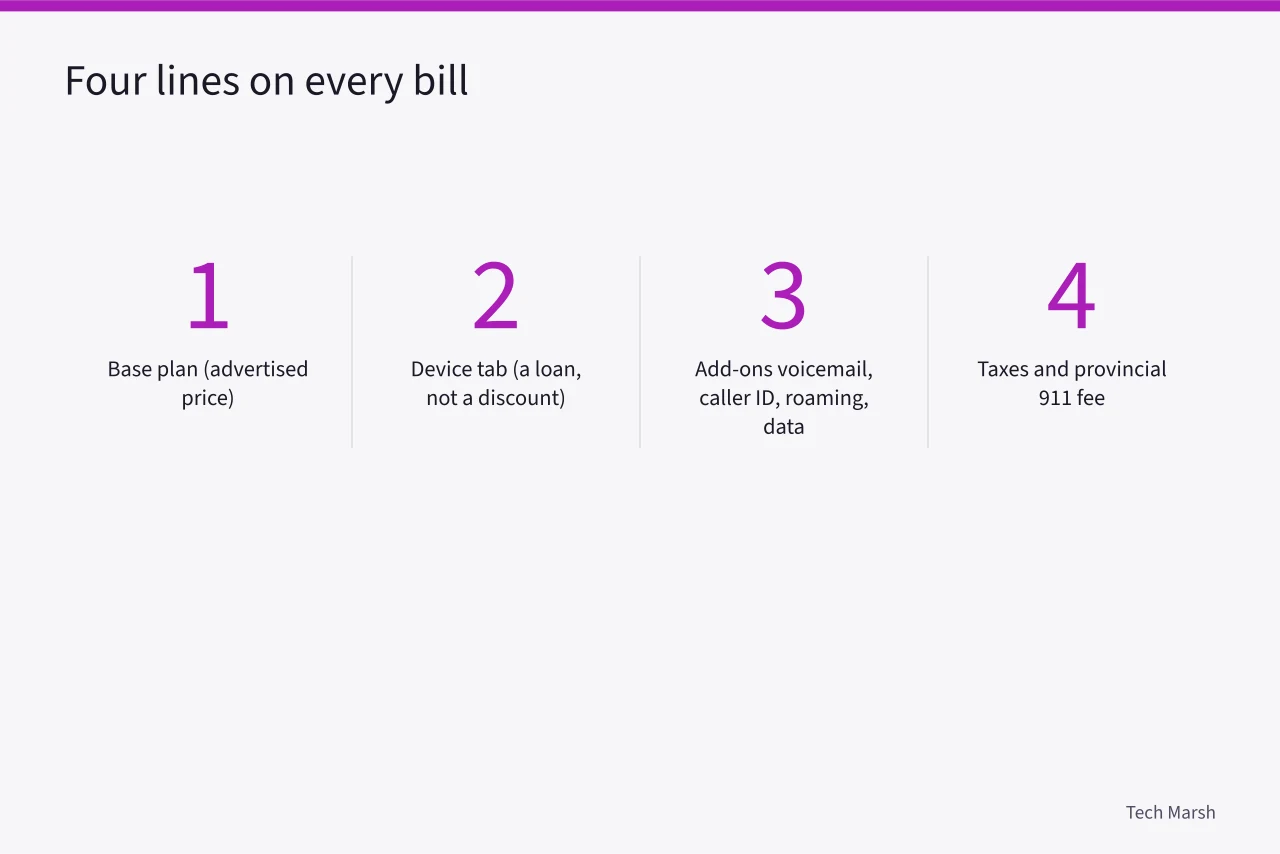
- The base plan, which is the advertised number.
- The device tab, if you financed a handset. This is a loan, not a discount.
- Add-ons: voicemail, caller ID, US roaming, extra data.
- Taxes and the provincial 911 fee, which vary by province.
Ontario and Quebec charge sales tax differently on telecom, and Quebec's 911 charge is set separately from Ontario's. That alone can shift a bill by a few dollars a month.
Fixed against variable
The base plan is fixed. You pay it whether you use 200MB or 19GB. Data overage, roaming and long distance are variable, and they are where bills grow.
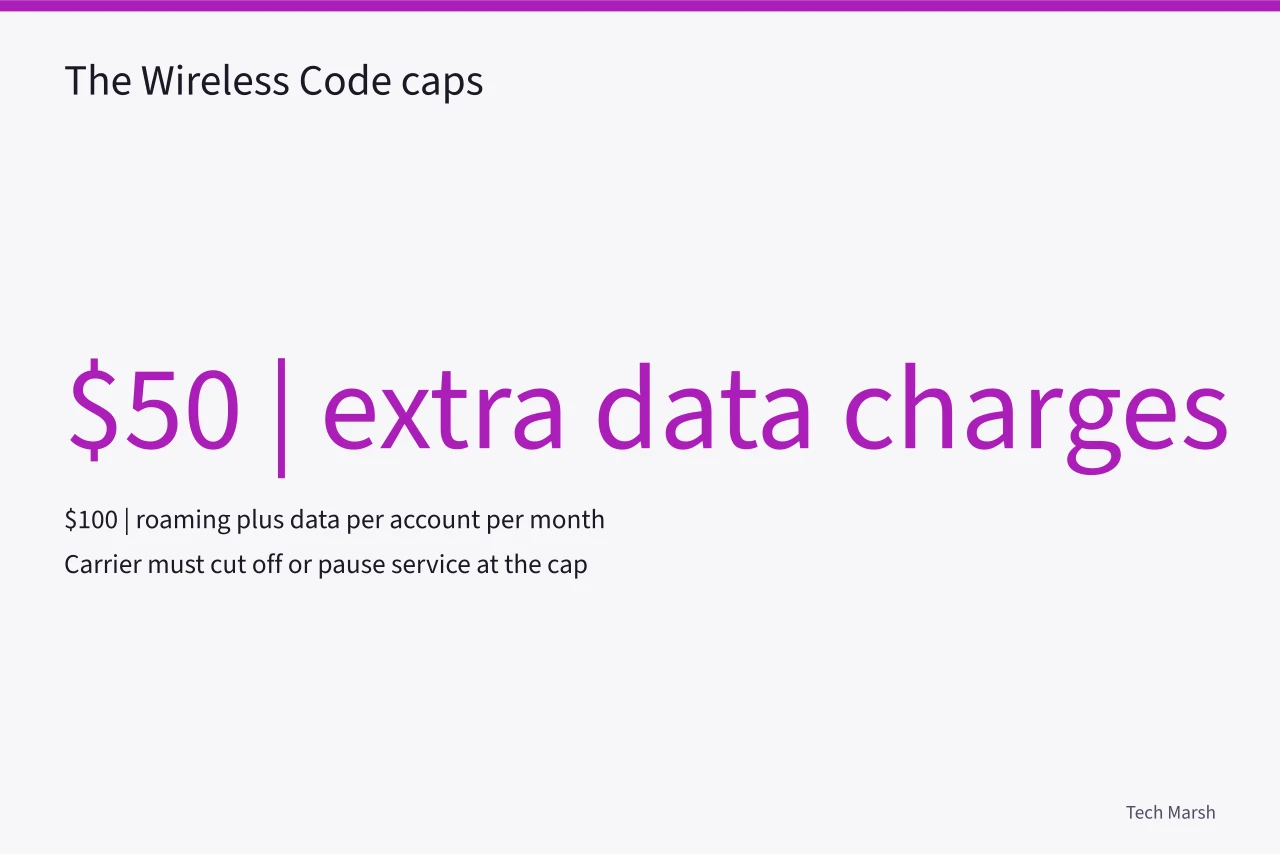
The CRTC Wireless Code sets two hard ceilings. Extra data charges stop at $50 in a single month, and roaming plus data charges stop at $100 per account per month unless you agree to more. The carrier must cut you off or pause the service at that point.
That cap is the single most useful protection for a budget user. It converts an open-ended risk into a known maximum. If you travel and keep data on, $100 is the worst case for the month, not $900.
What the tools do not include
Comparison sites and carrier calculators show the advertised plan price. They leave out four things.
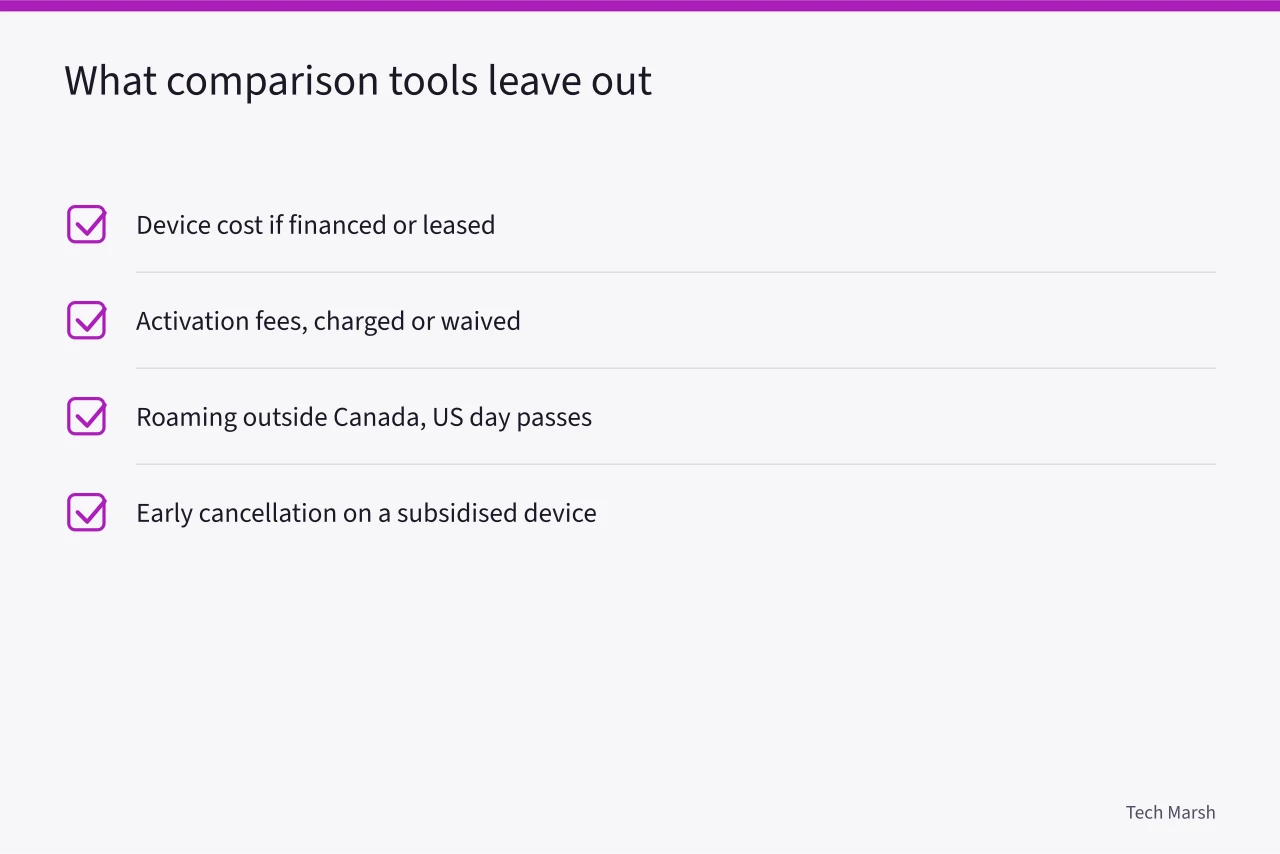
- Device cost, if the phone is financed or leased
- Activation fees, which some brands charge and some waive
- Roaming outside Canada, including US day passes
- Early cancellation on a subsidised device
The Wireless Code allows you to cancel a contract after 24 months at no cost, and caps the cancellation fee at the remaining device balance before that. It does not make the device free. A financed phone is still a debt.
If a used handset is part of your plan, check the IMEI before you buy. A blacklisted phone will not activate on any Canadian network, no matter how cheap the plan is.
Where budgets leak
Three leaks account for most of the gap between the advertised price and the real one.
A $34 plan with a $45 device tab and $12 in add-ons is a $91 plan. The advertised number was never the bill.
Roaming is the second leak. A week in the US without a travel add-on can cost more than a year of the plan itself. Buy the add-on before you leave, not after.
Overages are the third, and the $50 cap is the reason they stay bounded. Set a data warning in your phone settings at 80 percent of your bucket so the cap never triggers.
Province by province
Prices for the same 20GB plan differ by province because the number of competing carriers differs. Quebec has regional players such as Videotron and Fizz. Manitoba has Bell MTS. Saskatchewan has SaskTel. Ontario and the Atlantic provinces mostly have the big three plus their flankers.
That gap is real and it shows up in advertised pricing. A plan listed at $45 in Ontario can appear at $35 in Quebec or Manitoba. If you move provinces, ask for the local plan rather than keeping the old one. Porting your number is free and takes minutes.
Coverage matters more than a few dollars in rural areas. Check the carrier's own coverage map for your address before switching, because a cheap plan on a thin network is not cheap.
Choosing between the brands
The big three own the networks. Their flanker brands rent space on the same towers at lower prices, with less support and fewer retail locations.
Fido and Koodo and Virgin Plus sit in the mid tier. Chatr, Lucky Mobile and Public Mobile sit at the bottom, mostly prepaid, mostly 4G, mostly online support.
For a single line with modest data, a flanker prepaid plan is usually the cheapest route. For a family, a pooled plan on one of the mid-tier brands often beats four separate lines. Compare the total, not the headline.
If you are also sorting out home service, our reality check on internet speed explains why the advertised speed is rarely the speed you get.
Common questions
Can I keep my number if I switch to a cheaper carrier? Yes. Number porting is free and the CRTC requires the new carrier to handle it. Do not cancel the old plan first, or you may lose the number.
Is a prepaid plan worse than a postpaid one? No. Prepaid plans on Chatr, Lucky Mobile and Public Mobile use the same networks. You lose device financing and some roaming options, and you pay upfront.
What happens if I go over my data? The carrier charges per gigabyte until the $50 monthly cap, then service pauses unless you agree to more. Set a warning at 80 percent to stay under it.
Do I need a credit check for a budget plan? Prepaid plans usually skip the credit check. Postpaid plans with a device tab do require one, which is one more reason prepaid suits a tight budget.